HubSpot AEO: What It Is, What It Does, and What We Think So Far
We walked a client through setting up HubSpot's AEO tool last week. A government services consultancy with a few sub-brands, a specific set of competitors, and an audience that's increasingly turning to ChatGPT and Perplexity before they ever Google anything.
The setup took about fifteen minutes. The conversation about what the results actually mean took an hour. And that ratio is kind of the point.
AEO (Answer Engine Optimization) is one of HubSpot's newest tools. It launched at HubSpot's Spring 2026 Spotlight, built on technology from XFunnel, a company HubSpot acquired late last year. It's designed to answer a question we're hearing from clients constantly right now: when someone uses ChatGPT or Gemini or Perplexity to research solutions in your space, does your company show up?
For many companies, the honest answer is "we have no idea." AEO changes that.
Why This Matters Right Now
Here's the shift happening underneath all of our marketing strategies: buyers are researching in AI tools before they visit a website. According to HubSpot's own data, AI referral traffic has tripled, and AI-referred leads convert at 3x the rate of traditional search leads.
The 2026 HubSpot State of Marketing report found that 58% of marketers say visitors referred by AI tools convert at higher rates than traditional organic traffic. And HubSpot's January 2026 data shows 42% of CRM software buyers now use AI search as part of their evaluation process.
This isn't a future prediction. This is how people are researching right now. And if your brand isn't showing up in those AI-generated answers, you're invisible at the exact moment a potential buyer is forming their shortlist.
Traditional SEO isn't going away. But it's no longer the whole picture. As Constellation Research analyst Liz Miller told TechTarget, SEO is about content authenticity and ranking. AEO is about authority, about being cited and referenced when AI synthesizes answers for users. They're different muscles.
What HubSpot AEO Actually Does
According to HubSpot's AEO product page, the tool gives you four things: a visibility score, prompt tracking, citation analysis, and prioritized recommendations.
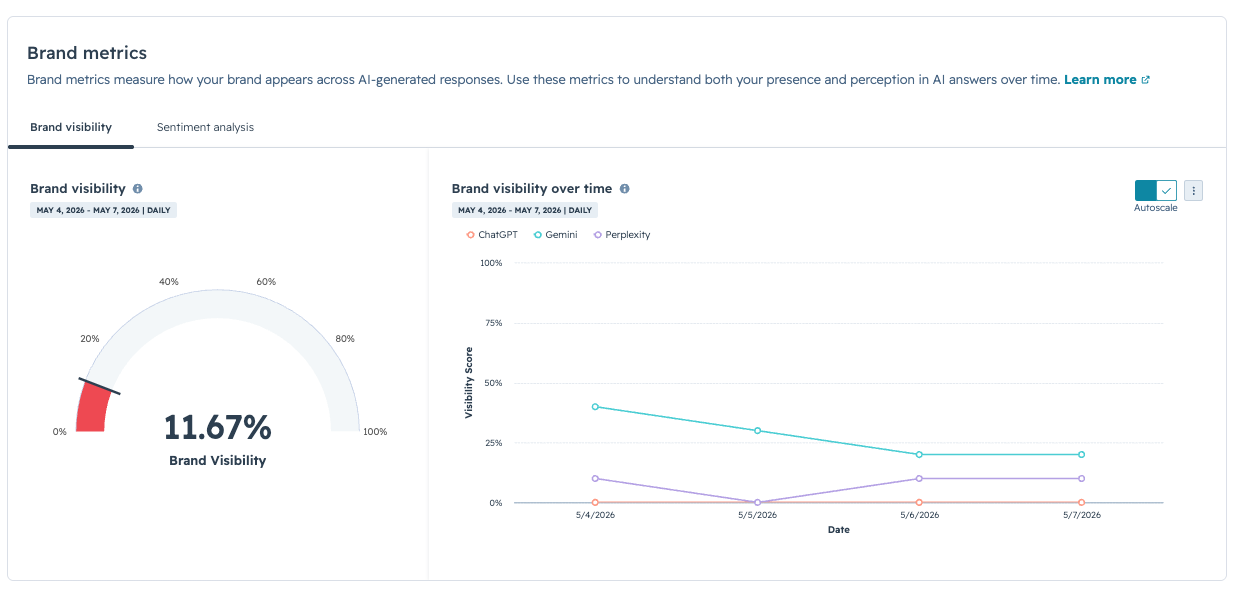
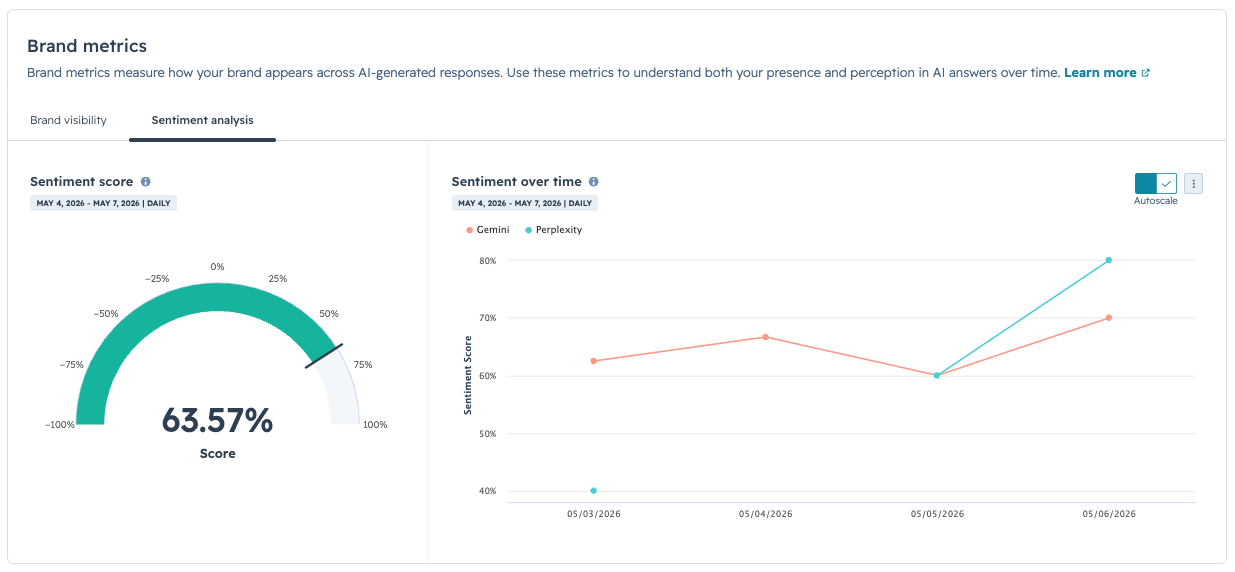
Visibility score. This tells you how often your brand appears in AI-generated answers across ChatGPT, Gemini, and Perplexity. Per HubSpot's GEO tool documentation, every prompt runs daily, so your score reflects current reality, not a snapshot from last month. It also tracks sentiment, whether AI is describing your brand positively, negatively, or neutrally.
Prompt tracking. The tool suggests prompts your customers are likely asking and monitors whether you're showing up in the responses. You can also add your own. This is where you start to see the gaps, the questions people are asking where your competitors appear and you don't.
Citation analysis. This shows you which domains, pages, and content types are being referenced in AI answers in your category. When you can see what AI is pulling from, you know what kind of content to create or improve.
Recommendations. When the tool identifies a gap, it tells you what to do about it. What to create, what to update, where to build presence. Content actions (the ability to act on recommendations directly inside HubSpot) are coming in June 2026.
What We Saw When We Set It Up
Here's where it gets real. Setting up AEO for our government services consultancy involved a few steps that seem simple but require some thought.
Brand names are case-sensitive. The tool looks for exact matches. If your company shows up as different capitalizations or abbreviations across different contexts, you need to account for all the variations. We spent time thinking through which versions were most likely to appear in AI responses. If you have sub-brands or affiliated organizations, those need to be entered separately.
Competitors require judgment. The tool suggests competitors based on your inputs, but this is where we'd encourage you to come prepared with your own list. The AI suggestions were... fine. Some were relevant, some were pulling from adjacent categories rather than actual competitors. We ended up removing the suggestions and adding the real ones manually. If you know who you compete with, bring that list.
Product category can be tricky. For a consultancy, the long-tail description of what you do doesn't always fit neatly into a category. We went broad and planned to refine based on results. This is a first-pass exercise. You can always adjust.
ICP and geography matter. Who would you want to show up for if someone was using an LLM to make decisions? That's a different question than "who visits our website." For our client, the answer was journalists and researchers, primarily in the US but with international reach. Your answer will be different. Think about it before you sit down with the tool.
Our Honest Take
We've been working with AEO concepts for a few months now, using Semrush and other tools, for prompt data and manually tracking where brands appear in AI responses. HubSpot's tool puts a lot of that into one place, which is genuinely helpful.
A few things we think the tool does well:
Tracking over time is valuable. Knowing where you stand today is interesting. Knowing whether your visibility is improving week over week is actionable. This is where the tool earns its keep.
The distinction between source and brand mention matters. The tool differentiates between being cited as a source (AI references your content in its answer) and being mentioned as a brand (AI names you directly in its recommendation). Being cited as a source often comes first. Getting the brand mention is the goal. Understanding that progression helps you set realistic expectations.
CRM integration is the differentiator. As Diginomica noted, the fact that HubSpot's AEO tool is integrated directly with its CRM and all that customer data is what sets it apart. Having all the context is critical to creating content that truly reflects the brand. Other AEO tools exist, but starting from your business context instead of generic categories is a meaningful advantage.
A few things to take with a grain of salt:
The AI-suggested prompts are the weakest part right now. We've found that prompts sourced from tools like Semrush, ahrefs, etc (based on what people are actually searching) tend to be more reflective of reality than what the tool auto-generates. Use the suggestions as a starting point, but don't rely on them exclusively. Add your own based on what you're hearing from prospects and what you're seeing in search data.
There's no prompt difficulty metric yet. In SEO, you can see how hard it would be to rank for a given keyword. AEO doesn't have an equivalent yet. So when the tool recommends going after a certain prompt, there's no way to gauge how much effort it would take to appear in those answers. You're working a bit by feel.
The content recommendations lean toward listicles. The tool analyzes what content types AI tends to cite and often recommends list-style content. That makes sense from a data perspective, but it doesn't always fit every brand. A consultancy probably shouldn't publish "Top 10 Government Infrastructure Strategies" just because AI likes lists. Use the recommendations as directional input, not a content calendar.
The tool is brand new. It's weeks old. It will get better. The tracking and monitoring capabilities are solid right now. The recommendations and suggested prompts will improve as HubSpot refines the product. Worth getting in now to establish a baseline, but set expectations accordingly.
Why We're Still Excited About It
Despite the rough edges, this is the right direction. Diginomica reported that HubSpot's internal data shows customer traffic is down 27% year over year, but customers using the AEO beta and prioritizing answer engines have seen referral traffic grow 20%.
The shift is real. Buyers are researching in AI tools. Your brand either shows up in those answers or it doesn't. And until now, many companies had no way to even know which side of that line they were on.
HubSpot AEO gives you that visibility. It's not perfect yet, but it's the first tool we've seen that connects AEO insight to the platform where you're already doing the work. Monitor where you stand, see where the gaps are, and build toward showing up in the conversations your buyers are already having, whether they ever visit your website or not.
How to Get Started
HubSpot AEO is included in Marketing Hub Pro and Enterprise, or available as a standalone subscription for $50/month. There's also a free AEO Grader that gives you a one-time snapshot of how AI currently characterizes your brand.
Setup takes minutes. The real work is knowing what to do with the results. That's where we come in.
If you want help setting up AEO, interpreting what you're seeing, and building a strategy to improve your AI visibility, that's what we do.