
Top CRM Implementation Services: How to Pick the Right Partner
If you're a small business shopping for a CRM implementation partner, here's the short version: the right partner depends on how complex your data is, how much customization you need, and whether you want someone who disappears after setup or sticks around. Most growing businesses do best with a consulting firm that handles discovery, process mapping, setup, migration, customization, training, and ongoing support under one umbrella, not five different vendors.
Below is a breakdown of the main CRM implementation service options, what each one actually covers, and how to tell which is the right fit.
What does a CRM implementation service actually do?
A good CRM implementation service covers seven things:
Discovery and process mapping (understanding how work actually flows through your team today, including every handoff)
Setup and configuration (getting your CRM, usually HubSpot, properly structured)
Data migration (moving contacts, deals, and history from your old system without losing the good stuff)
Customization (pipelines, properties, lifecycle stages, lead scoring, workflows)
Integrations (connecting your CRM to your other tools, accounting, support, marketing)
Training (making sure your team actually uses the thing)
Ongoing support (because you'll have questions three months in, and you shouldn't have to start over)
If a provider skips the first one, the other six will be built on guesses.
Why process mapping is part of the job
You can't build a system without the process. Before anyone builds a pipeline, someone needs to map how your business actually runs. Not the org chart version. The real one.
Who touches a lead first? What happens when they don't respond? Who owns the handoff from marketing to sales, and what's the trigger? What information does ops need before they can fulfill? Where are people copy-pasting data between tools because the system doesn't talk to itself?
The handoff question is the one most teams underestimate. Sales to onboarding. Onboarding to ops. Ops to support. Every handoff is a place where data gets dropped and context gets lost. Good implementation spends real time on each one.
The main types of CRM implementation service providers
1. Platform-direct onboarding (e.g., HubSpot's own onboarding)
Best for: Companies with simple needs, clean data, and an internal admin who has time to learn.
HubSpot's direct onboarding gets you through the technical setup. It's fine. But it's structured, not customized. You'll get templates and walkthroughs, not a partner who sits in a room with your team and asks why the handoff between sales and ops keeps breaking.
Watch out for: Data migration and process mapping are usually your problem, not theirs. If you're coming from Salesforce or a messy spreadsheet situation, you'll need help.
2. Freelance HubSpot consultants
Best for: Single-project work with a clear scope (a workflow build, a quick audit, a property cleanup).
Freelancers can be fantastic for tactical work. The risk is continuity. If your freelancer takes a new full-time job, your CRM knowledge walks out the door.
Watch out for: Scope creep without structure. Good freelancers are booked solid and expensive. Cheap freelancers often lack the depth to handle complex migrations, integrations, or the kind of discovery work that actually uncovers your real process issues.
3. HubSpot Solutions Partners (agencies and boutique consulting firms)
Best for: Companies that want a full implementation plus a long-term relationship.
Solutions Partners are vetted by HubSpot and come in every size. Big agencies with 50+ people. Mid-size shops. And tiny boutique firms (two-to-five-person teams) that operate with partner-level credentials but a freelancer feel, which is honestly the sweet spot for most $10M–$50M companies. You get senior-level expertise, direct access to the person actually doing the work, no account manager layers, and a real partner relationship.
The good ones start with discovery, map your actual processes and handoffs, and only then move to migration, setup, customization, training, and ongoing admin support.
This is where a fractional HubSpot admin model often shines. Not every $10M–$50M company needs a full-time HubSpot admin, but most need more than a one-time setup. Fractional means you get senior-level expertise on the hours you actually need it, usually 10–15 hours a month on retainer.
Watch out for: Agencies that bundle HubSpot into a bigger marketing retainer. If HubSpot is 10% of what they do, it's probably 10% of their focus. Ask what percentage of their revenue comes from HubSpot work specifically.
4. In-house hire
Best for: Companies with enough HubSpot work to justify a full-time salary (usually $80K–$130K + benefits).
If HubSpot is central to your revenue operations and you have 40+ hours a week of real work for them, hiring is the right move.
Watch out for: Hiring too early. A lot of small companies hire a HubSpot admin before they have the processes, the data, or the volume to justify it. The admin ends up doing marketing, ops, and project management, then leaves because the role wasn't what they signed up for.
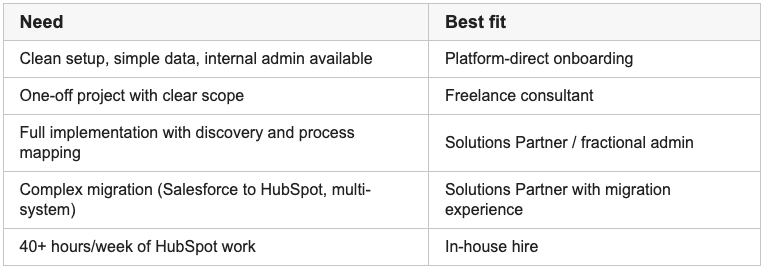
How to choose: a quick comparison
What good CRM implementation actually looks like
A few examples from real engagements (names omitted):
A healthcare company spent two weeks in discovery before a single property was created. Five teams, eighteen sessions. That's where the phantom invoice issue surfaced, along with three payment systems that never reconciled.
A B2B manufacturing company needed a deal rotation workflow that assigned leads by zip code and escalated to management if nobody followed up in 24 hours. Not a template. Someone understanding how their sales team actually works.
An aftermarket automotive parts company rebuilt their deal pipeline because the stages didn't match how they sold. Quote templates, product libraries, and attribution reporting came next. They could finally see what marketing was driving.
A B2B SaaS company needed a lifecycle stage workshop before anyone touched HubSpot, because their MQL and SQL definitions were unclear. Clean the definitions, the scoring follows.
The common thread: good implementation starts with stakeholder interviews (what do you love, what do you hate), then process mapping, then an audit week, then phased rollout. Not a template dump.
Questions to ask any CRM implementation partner
How do you handle discovery and process mapping before the build?
How do you approach handoffs between teams (marketing, sales, ops, support)?
How do you handle data migration from [your current system]?
Do you offer ongoing support after implementation, or is it setup-only?
Can you show me a real workflow or customization you've built for a similar company?
How do you handle training, and what happens when our team has questions six months later?
If they give you vague answers on any of these, keep shopping. Especially the first two.
The short answer
For most growing companies, the right partner is a HubSpot Solutions Partner that starts with process mapping, handles the full build, and sticks around after go-live as a fractional admin.
Anneomaly Digital is a HubSpot Gold Partner, two-person team. Partner credentials, freelancer feel, 14 years in the platform. No account managers, no layers, direct access to the person actually doing the work.
If you want to talk through what a good implementation could look like for your team, that's what we do.